In this article
- What should a fitness program for older adults include?
- Is strength training safe for older adults?
- How heavy should older adults lift?
- How often should older adults do strength training?
- Which strength exercises should older adults start with?
- Why does balance training matter as you get older?
- Can strength training help bone health?
- Can older adults do strength training at home?
- What does a first week of strength training look like?
- Should older adults start with a personal trainer or a class?
- What if you have a health condition or have not trained for years?
The short answer: Good fitness programs for older adults start with two strength sessions a week that work every main muscle group. Begin with body weight or light weights, then add load. Add balance work on three days and stay active most days. That matches Australia's guidelines for adults 65 and over. Check with your GP first if you have a health condition.
People ask us the same question in different ways. Am I too late? Is it safe? Where do I even start?
The answers are no, yes, and here. Good fitness programs for older adults are not complicated. They are structured. They start simple. They build every few weeks. And they are reviewed along the way.
This guide to strength training for older adults covers what a program should include, how heavy to lift, how often to train, the first strength training exercises to learn, and what a first week looks like.
What should a fitness program for older adults include?
A complete program has four parts: strength training on two or more days, balance work on three or more days, regular moderate activity, and less time sitting. Strength is the part most people miss.
Australia's 24-Hour Movement Guidelines set out what adults 65 and over need each week:
- moderate to vigorous activity for 30 minutes or more on most days, adding up to 2.5 hours or more a week
- muscle-strengthening activities that involve all main muscle groups on 2 or more days
- activities for mobility, balance and coordination on 3 or more days
- several hours of light activity each day, and less time sitting
The main muscle groups are the legs, back, abdomen, chest, shoulders and arms.
Walking covers the first point for many people. The second is where most fall short. That is where we start.
Strength is not one goal among many. It supports the rest. Climbing stairs. Carrying shopping bags. Getting up off the floor.
Is strength training safe for older adults?
For most healthy older adults, yes, when it is coached and builds up gradually. If you have a health condition, check with your GP first.
The National Strength and Conditioning Association, a professional body for strength coaches, reviewed the research in its 2019 position statement. Its conclusion was clear:
"[C]urrent research has demonstrated that countering muscle disuse through resistance training is a powerful intervention to combat the loss of muscle strength and muscle mass, physiological vulnerability, and their debilitating consequences on physical functioning, mobility, independence, chronic disease management, psychological well-being, quality of life, and healthy life expectancy."
A 2026 meta-analysis compared heavier and lighter training in adults 50 and over. It pooled 18 trials with 1,283 participants. It found no significant difference in adverse events between the two.
In strength training for seniors, safety comes from three things. Good technique. A starting load you can control. Progress that is planned, not rushed.
Healthdirect gives a simple rule. Exercise for older adults should involve some effort, but it should not cause pain. Stop and see your doctor if you have trouble catching your breath or persistent pain in your joints or muscles. For severe chest pain or shortness of breath, call triple zero (000).
How heavy should older adults lift?
Start light enough to learn each movement well. Then build up. In trials, heavier training built more leg strength in older adults than lighter training, once people were ready for it.
The 2026 meta-analysis defined heavier training as 70% or more of a one-rep maximum. That is the most you can lift once. Heavier training improved leg press strength and leg extension strength more than lighter training. Both approaches were similar for bone density.
Nobody needs to test a one-rep maximum in week one. We use a simpler guide.
| Weeks | Choose a weight you could lift | Focus |
|---|---|---|
| 1 to 4 | About four more times | Learn each movement |
| 5 to 8 | Two or three more times | Build load slowly |
| 9 onwards | Two or three more times, then add a little | Steady progress, reviewed every four weeks |
Australia's guidelines ask for muscle-strengthening work at moderate or greater intensity. On a 0 to 10 effort scale, that is about a 5 or 6. Your last two reps should feel hard. Your form should still look the same as your first.
How often should older adults do strength training?
Twice a week is the right start. Leave a day or two between sessions. Once two sessions feel routine, some people add a third.
Healthdirect says to include strength training at least twice a week, with 48 hours of rest between sessions. Australia's guidelines say two or more days.
Monday and Thursday works. So does Tuesday and Friday. Pick days you can keep.
Each session can be short. Thirty to 45 minutes is enough for:
- a five-minute warm-up on the bike or a brisk walk
- four to six exercises that cover the whole body
- two or three sets of each, with 8 to 12 reps
- a few minutes of balance work to finish
Two sessions every week beat four sessions in a good week and none in a busy one.
Consistency first. Progress follows.
Which strength exercises should older adults start with?
Start with four movements: a squat, a hip hinge, a wall push-up and a single-leg balance. They train the legs, hips, back, chest and arms. They also build the patterns you use every day.
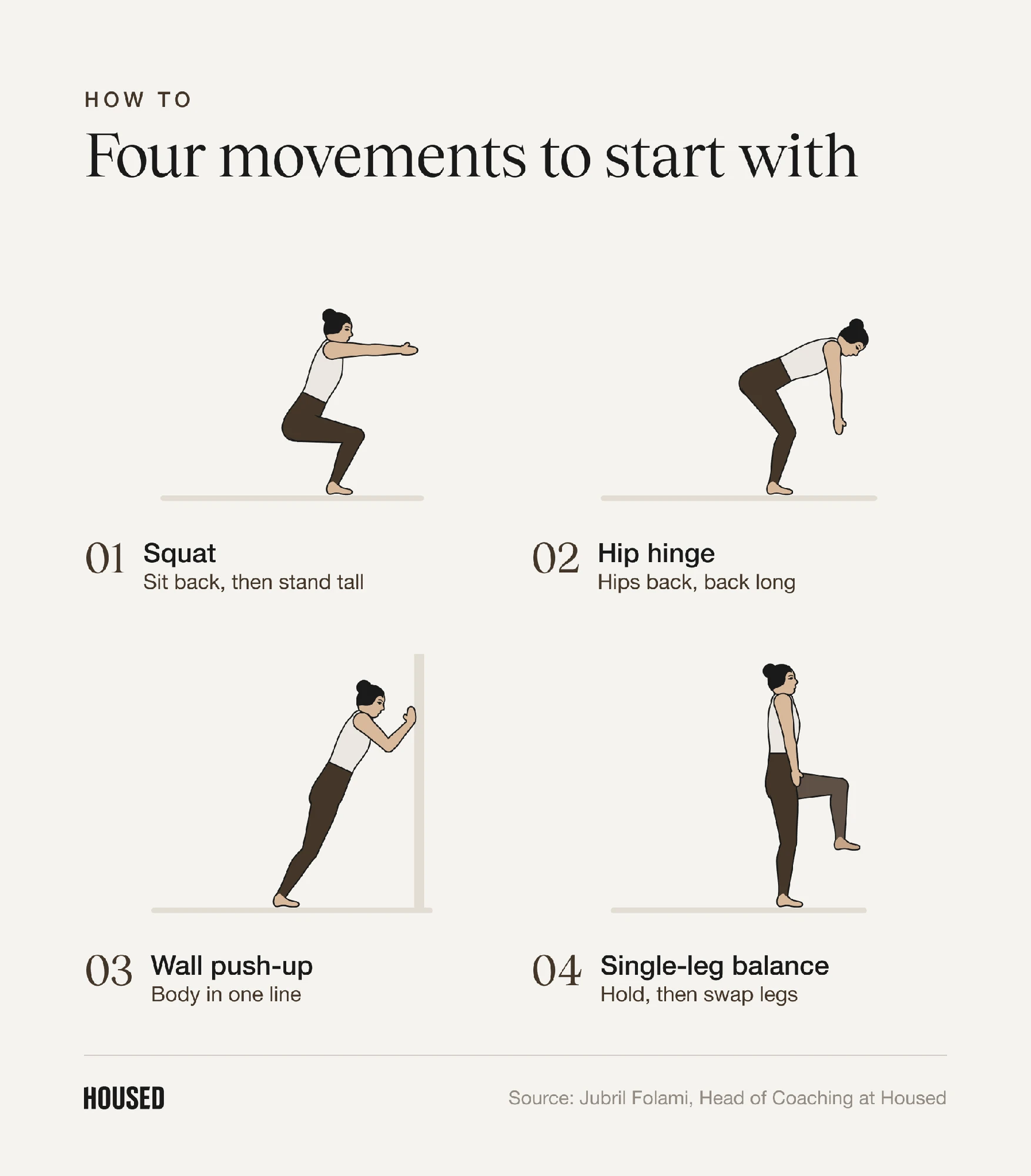
- 01Squat. Stand with feet hip-width apart. Sit your hips back and down, as if to a chair. Keep your chest up. Stand tall again. Use a chair behind you at first.
- 02Hip hinge. Stand tall with soft knees. Push your hips back. Keep your back long. Lower your hands towards your knees. Squeeze your glutes to stand.
- 03Wall push-up. Place your hands on a wall at shoulder height. Step your feet back. Keep your body in one line. Lower your chest towards the wall. Press back.
- 04Single-leg balance. Stand tall next to a wall or a rack. Lift one knee. Hold for up to 30 seconds. Swap legs. Touch the wall if you need to.
Do two sets of 8 to 12 reps of the first three. Do two holds on each leg for the balance.
When these feel steady, we add load and new movements. A goblet squat holding a dumbbell. A Romanian deadlift. A seated row on a cable machine. A farmers carry with two dumbbells.
Every movement has a purpose. Nothing is random.
Why does balance training matter as you get older?
Balance training reduced falls in older adults in many trials. It works best combined with strength training. That is why Australia's guidelines include balance work on three or more days a week.
A 2019 Cochrane review pooled 108 trials with 23,407 people living in the community. Their average age was 76. Exercise of all types reduced the rate of falls by 23%. Balance and functional exercises reduced it by 24%. Programs that combined several types, most often balance and strength, probably reduced it by 34%.
The review was less certain about strength training alone. That is the point. To reduce the risk of falls, strength and balance work best together.
Exercises for improving balance do not need special equipment:
- standing on one leg, holding a support at first
- walking heel to toe along a line
- stepping up onto a low step, slowly
- standing up from a chair without using your hands
Healthdirect also lists tai chi and heel-to-toe walking as balance activities.
Two minutes at the end of each session is a good start. Do it on a third day too, after a walk.
Can strength training help bone health?
It may help. One trial found that heavy, closely supervised training improved bone density in women with low bone mass. If you have osteoporosis or low bone density, talk to your doctor before you start.
The LIFTMOR trial, published in 2018, followed 101 postmenopausal women with low bone mass. Their average age was 65. Half did two 30-minute supervised sessions a week for eight months. They lifted heavy, five sets of five reps at over 85% of their maximum, with impact work. The other half did a home program of low-intensity exercise.
The supervised group improved bone density at the lower spine by 2.9%, while the home group lost 1.2%. The supervised group also improved on every measure of physical function. There was one minor adverse event, a back spasm.
Two details matter. The participants were screened for conditions and medications first. Every session was closely supervised.
So this is not a reason to lift heavy alone. It is a reason to ask your doctor, then train with a coach.
Can older adults do strength training at home?
Yes. Body weight, a sturdy chair, a wall and a resistance band are enough to start. Home sessions count towards the guidelines, as long as they work every main muscle group at a moderate effort.
Australia's movement guidelines list push-ups, lifting weights, circuit training, working with resistance bands and heavy gardening as muscle-strengthening activities.
A home version of the four movements:
- Squat: sit down to a chair and stand up again, arms crossed.
- Hip hinge: hold a full shopping bag in each hand.
- Wall push-up: exactly as above.
- Single-leg balance: next to a kitchen bench you can hold.
- Row: a resistance band looped around a sturdy door handle.
Home training has one limit. It is hard to add load. After a few months, most people need heavier weights to keep progressing. That is when a gym floor helps.
Start at home if that is what gets you going. Just plan the next step.
What does a first week of strength training look like?
A first week has two strength sessions, two or three walks and a little balance work. It should leave you feeling like you could have done more.
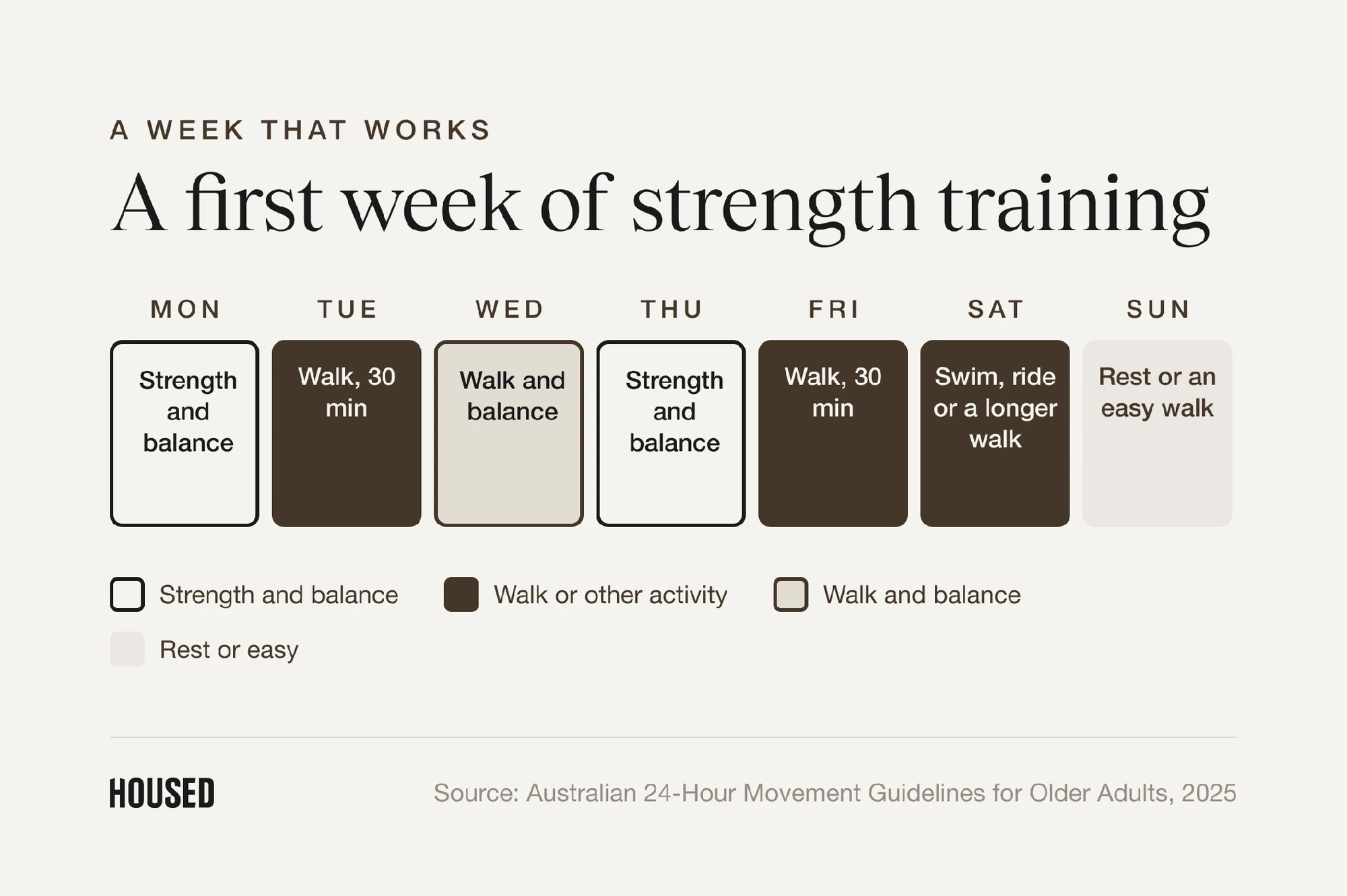
- Monday: strength and balance, 30 to 45 minutes
- Tuesday: a 30-minute walk
- Wednesday: a walk, then five minutes of balance work
- Thursday: strength and balance, 30 to 45 minutes
- Friday: a 30-minute walk
- Saturday: a swim, a ride or a longer walk
- Sunday: rest, or an easy walk
Some soreness a day or two after the first sessions is normal. It should fade as your body adapts. Pain in a joint is different. Stop that exercise and tell your coach.
We build programs in phases. Four weeks to learn the movements. Four weeks to add load. Then a review. What moved? What felt hard? What comes next?
That is the standard. Every phase has a purpose.
Should older adults start with a personal trainer or a class?
Either works. A personal trainer suits you if you have never lifted, have an injury to work around, or want a program built for you. A coached class suits you if you like company and a set time.
At Housed, personal training starts with a movement and lifestyle assessment and a conversation about your goals. Then you get an introduction to your program. Your coach tracks your strength, consistency and technique, and adjusts the program as you improve.
Group Training runs at Housed Macquarie Park and Penrith. Foundations is our all-levels strength class. It coaches the squat, hinge, push and pull patterns with real attention to technique. Check when it runs on the timetable.
New to Housed? Try the gym floor and a class first. Get a free pass.
What if you have a health condition or have not trained for years?
Talk to your GP before you start. Tell your coach about every condition, injury and medication. Then start lower and build more slowly. Most people can still train. The program changes to fit you.
Australia's guidelines include separate advice for adults and older adults with chronic conditions. The core message is the same: start with small amounts and build up the frequency, intensity or duration over time.
Conditions that need a conversation with your doctor first include:
- heart disease, high blood pressure or diabetes
- osteoporosis, a past fracture or a joint replacement
- dizziness, falls or balance problems
- recent surgery, or an injury that still hurts
For a condition that needs a clinical exercise program, an Accredited Exercise Physiologist can help. A physiotherapist can help with pain or an injury. A coach can then take over the strength work once you are cleared.
Not training for years is not a problem. It just sets the starting point.
You do not need to be fit to start. You need a plan, a coach and two days a week.
Book the first session. Then the second. That is how it starts.
Sources
- 01Australian Government Department of Health, Disability and Ageing. "Australian 24-Hour Movement Guidelines for Adults (18-64 years) and Older Adults (65+ years)." 2025. health.gov.au
- 02Fragala MS, Cadore EL, Dorgo S, et al. "Resistance Training for Older Adults: Position Statement From the National Strength and Conditioning Association." Journal of Strength and Conditioning Research 33(8):2019-2052, 2019. doi.org/10.1519/jsc.0000000000003230
- 03Shen YC, Chen KH, Hou WH, et al. "Effectiveness of High-Intensity Versus Low-To-Moderate-Intensity Resistance Training in Improving Muscle Strength and Bone Mineral Density in Older Adults: A Systematic Review and Meta-Analysis of Randomized Controlled Trials." Geriatrics & Gerontology International 26:e70607, 2026. doi.org/10.1111/ggi.70607
- 04Healthdirect Australia. "Physical activity guidelines for older people." 2024. healthdirect.gov.au
- 05Sherrington C, Fairhall NJ, Wallbank GK, et al. "Exercise for Preventing Falls in Older People Living in the Community." Cochrane Database of Systematic Reviews 1:CD012424, 2019. doi.org/10.1002/14651858.cd012424.pub2
- 06Watson SL, Weeks BK, Weis LJ, et al. "High-Intensity Resistance and Impact Training Improves Bone Mineral Density and Physical Function in Postmenopausal Women With Osteopenia and Osteoporosis: The LIFTMOR Randomized Controlled Trial." Journal of Bone and Mineral Research 33(2):211-220, 2018. doi.org/10.1002/jbmr.3284