In this article
- What is a run club, and what kinds are there?
- Why are so many people joining run clubs?
- Can you join a run club if you cannot run 5 km yet?
- How do you find a run club near you?
- How fast do you need to be at your first run club?
- How much should a beginner run each week?
- Should new runners do strength training too?
- Which strength exercises should new runners do?
- What should you wear and bring to a run club?
- Who should check with a GP before they start running?
- How can a gym help you get ready for a run club?
The short answer: Run clubs for beginners work best when the club has an easy pace or run-walk group that waits for everyone. Find one through a community club, a running directory or people you know, then check the pace and route. If 5 km feels far off, build up with run-walk intervals, and keep two days a week for strength training.
Run clubs have grown fast. Strava's 2024 Year in Sport report recorded a 59% rise in running club participation worldwide in a single year.
Turning up to a first session can still feel like the hardest part: you do not know the pace, the route or anyone there. This guide covers how to find run clubs for beginners and how to get ready for your first session. It also covers how much to run in the first month, and when to check with a GP before you start running.
What is a run club, and what kinds are there?
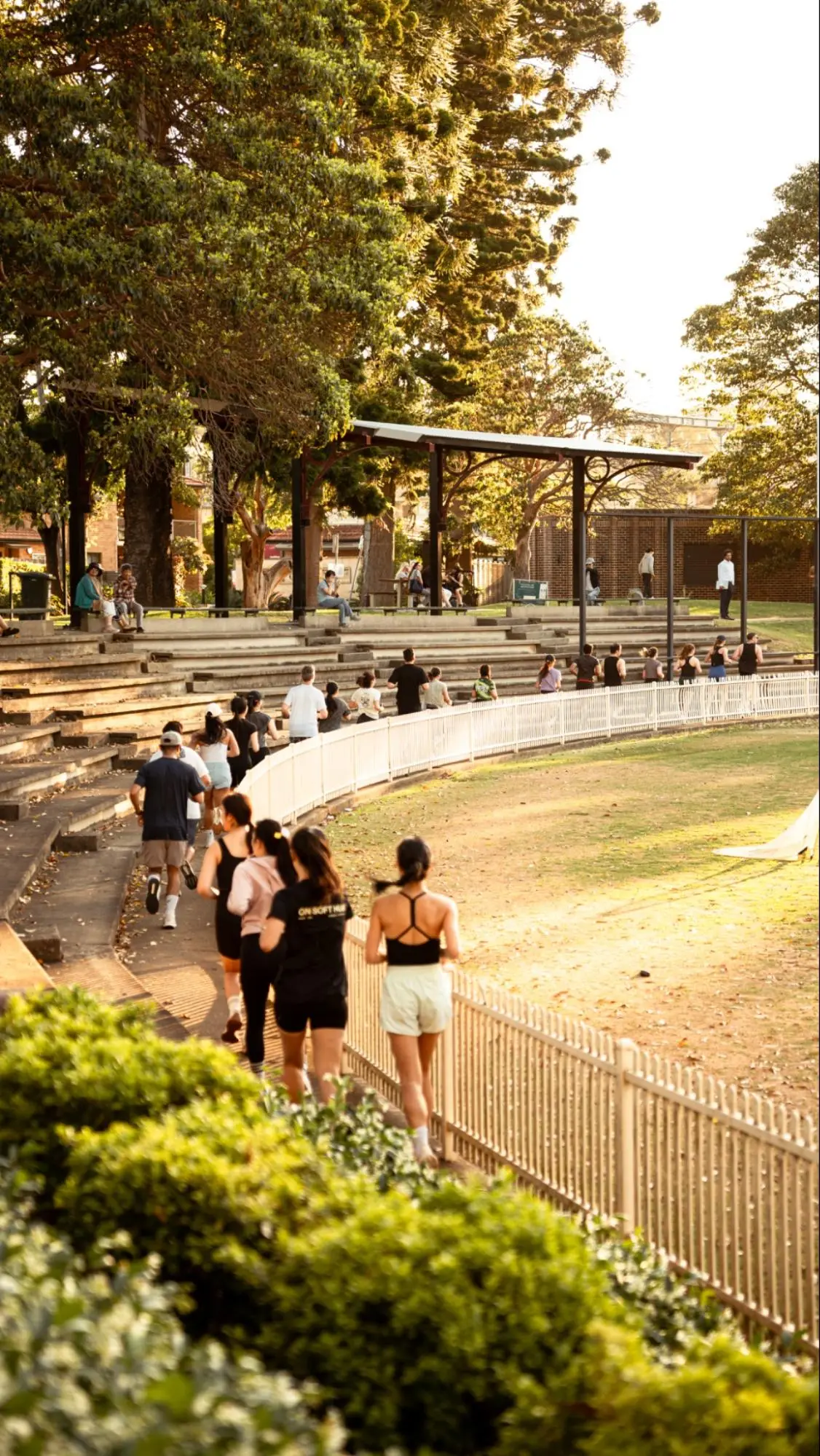
A run club is a group that meets at a set time and place to run together. The main kinds are social runs, run-and-walk groups, coached sessions and track nights. Social run clubs are the most common kind, and the easiest to try.
Most are free, and many welcome beginners. KeepActive's NSW listings show a price on every group: most are free, and a few charge a fee, coached groups among them. Some groups run sessions for women only, or mix women-only sessions with runs open to everyone.
The TCS Sydney Marathon Run Club is one free example. It is coach-led and open to all fitness levels and any pace. It runs relaxed 5 km group runs, plus community track nights at Sydney Olympic Park Athletic Centre, delivered with the NSW Office of Sport.
| Kind of run club | What happens | Cost | For a first session |
|---|---|---|---|
| Social run | A relaxed group run, often 5 km, that may end with a post-run coffee | Mostly free | A good start if there is an easy pace group or a regroup point |
| Run-and-walk group | A group that runs, jogs and walks at its own pace | Mostly free | The easiest way in if you cannot run 5 km yet |
| Coached session | Intervals and steady runs set by a coach | More likely to charge | Better once you can run for 30 minutes without stopping |
| Track night | Laps of an athletics track, such as a 5 km baseline run | Often free | Fine for any level if all abilities are welcome |
Why are so many people joining run clubs?
Company is a big part of it. In Strava's 2024 survey of more than 5,000 active people, making social connections was the lead reason people gave for exercising.
The same Strava report found that 58% of people surveyed had made new friends through fitness groups. Activities with more than 10 people lasted 40% longer on average than solo ones. Large group activities also had three times more downtime, which Strava reads as time for coffee or conversation. These figures come from Strava's own app data and survey, not from a peer-reviewed study.
Research points the same way, with care. A 2024 interview study of 39 men aged 45 to 64 who take part in parkrun in Ireland found they described it as welcoming and supportive. The men said the social connections they built over repeated weeks improved how they felt. It was a small interview study, so it describes their experience rather than proving an effect. Still, it shows what a running community can offer: a regular time, a familiar face and a reason to turn up.
Can you join a run club if you cannot run 5 km yet?
Yes, if the club has a beginner or run-walk group. If it does not, start at parkrun, where walking is welcome, and build up with run-walk intervals.
The NHS Couch to 5K plan is a free nine-week program built for exactly this. You run three times a week, with a rest day between runs, and every session starts and ends with a five-minute walk. Healthdirect suggests the same mix for support when you start: join a running group, or try programs like parkrun or Couch to 5K.
- Week 1: run for 1 minute, walk for 90 seconds, and repeat until you have run eight times.
- Week 3: run for 90 seconds and 3 minutes, with walks of the same length in between.
- Week 5: the third run of the week is 20 minutes without stopping.
- Week 7: 25 minutes of running, three times in the week.
- Week 9: 30 minutes of running without a walk break.
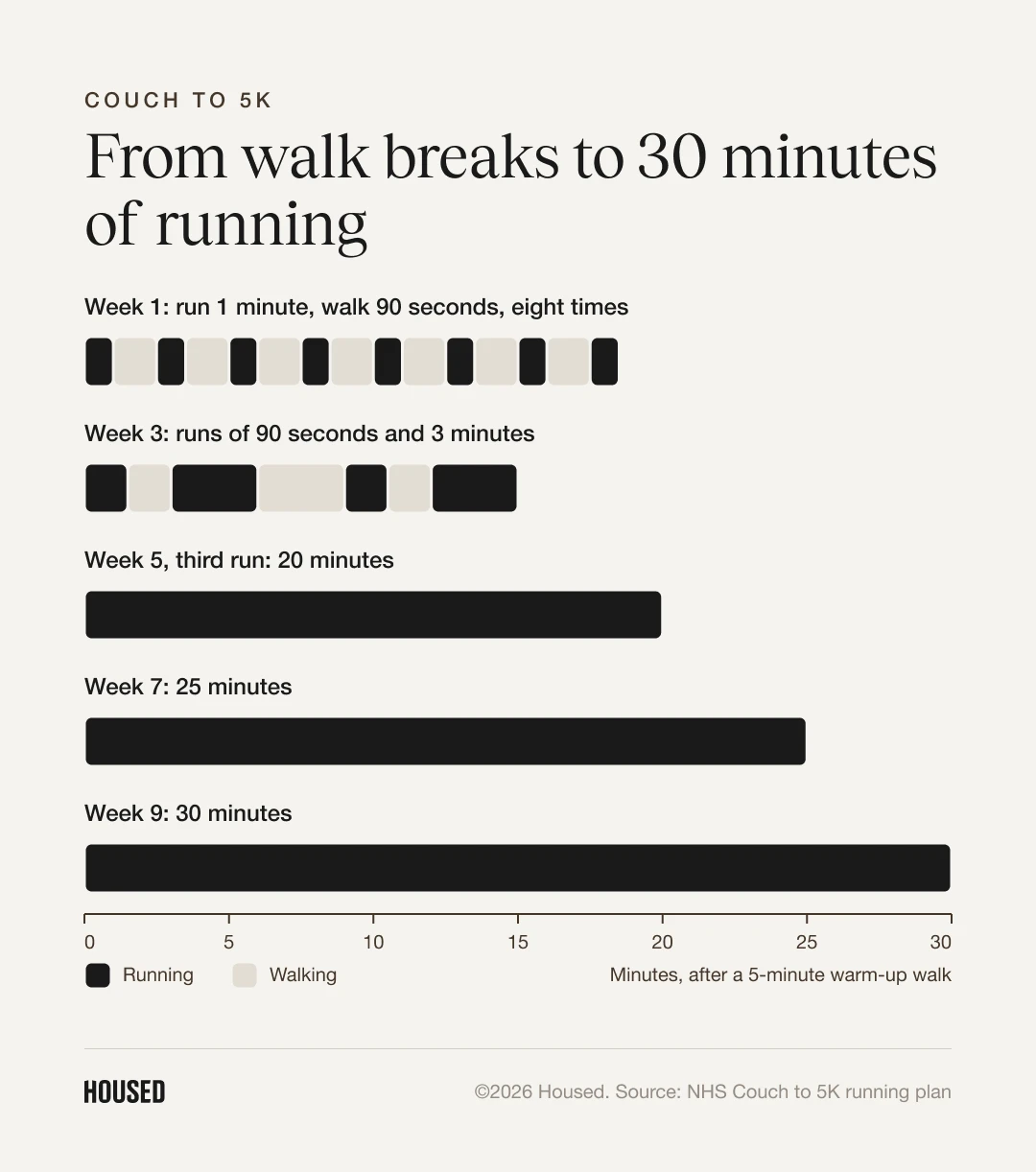
The plan suggests repeating a run or a week if it feels too hard. Taking 10 or 12 weeks instead of nine still gets you to the start line, and it is a better first month than one long run too soon.
How do you find a run club near you?
Start with a club that gives you more than the run itself: a good route, people at your pace, and somewhere to recover afterwards. That is what Housed run clubs are built around.
- 01Housed run clubs. Runs like Run & Rave mix a social group run with music and energy, then finish with time to cool down and connect. They are open to members and non-members, so you do not need a membership to come along.
- 02parkrun. Free, timed 5 km events run on Saturday mornings. Register online once before your first event, then turn up on the day.
- 03People you already know. Ask your gym, your workplace or your local running shop who runs together and when. Bring a friend to your first Housed run, because it is easier to turn up when someone is expecting you.
Before your first session, check four things on the club's page or by message:
- Pace groups. Is there an easy or beginner group?
- Distance. How long is the route, and can you turn back early?
- No-drop. Does the group regroup at corners, so nobody is left behind?
- The start. Where it meets, what time it leaves, and whether there is somewhere to leave a bag.
How fast do you need to be at your first run club?
You need a conversational pace: one you can hold while talking. Join the slowest group on offer, and tell the run leader it is your first session.
Most of a beginner's running should be at a moderate effort. Healthdirect describes moderate activity as exercise that "makes your heart rate go up but does not make you feel breathless". In practice, if you cannot answer a question in a short sentence, slow down or walk for a minute. A group's easy pace is often quicker than your own easy pace, so it is fine to drop back and run your own.
A few habits make the first session easier:
- Arrive 10 minutes early and introduce yourself to whoever is leading.
- Start at the back of the slowest group, where you can see the route ahead.
- Know where the route turns, so you can cut it short.
- Stay for the coffee or the walk back. Strava's data shows large groups stop and talk more than solo runners, and that is how a club comes to feel like yours.
How much should a beginner run each week?
Beginner running works best with two or three short runs a week, with rest days between them. Healthdirect suggests 24 to 48 hours of rest between runs and building distance gradually.
Going slowly matters most at the start. A 2015 review of 13 studies found novice runners had 17.8 running injuries per 1,000 hours of running, against 7.7 for recreational runners.
The most useful new evidence is about single runs, not weekly totals. A 2025 study in the British Journal of Sports Medicine tracked 5,205 adult runners through their Garmin watches for 18 months. Of those, 1,820 (35%) picked up an overuse injury. When one run was 10% to 30% longer than their longest run in the previous 30 days, the injury rate was 64% higher. When it was more than double, the rate was 2.28 times higher. Week-to-week changes in total distance showed no link. Long runs that jump well past your recent longest are where the risk sits.
Associate Professor Rasmus Ø. Nielsen of Aarhus University's Department of Public Health put it this way in the university's release on the study:
"We previously believed that injuries develop gradually over time, but it turns out that many injuries occur because runners make training errors in a single training session."
For a run club, that gives you a simple rule. Check the route length against your longest run in the past month. If your longest run is 4 km and the club runs 8 km, run about 4 km, then turn back or meet the group at the finish.
Should new runners do strength training too?
Yes. Australia's movement guidelines recommend muscle-strengthening activities on two or more days a week, and in a large review of trials, strength training lowered sports injuries.
The Australian 24-hour movement guidelines for adults aged 18 to 64 recommend moderate to vigorous activity for 30 minutes or more on most days. They also recommend muscle-strengthening activities on two or more days a week. A run club covers the first. It does not cover the second.
A 2014 review of 25 trials with 26,610 participants across many sports found strength training reduced sports injuries to less than a third, while stretching showed no benefit. Strength work can also make running more economical. A 2024 review of controlled studies in 652 middle- and long-distance runners found heavy strength training and combined methods improved running economy, the energy you use at a given speed. Plyometric training (jumps and hops) helped at speeds of 12 km/h or less. Those runners were already trained, so the evidence in beginners is thinner.
Which strength exercises should new runners do?
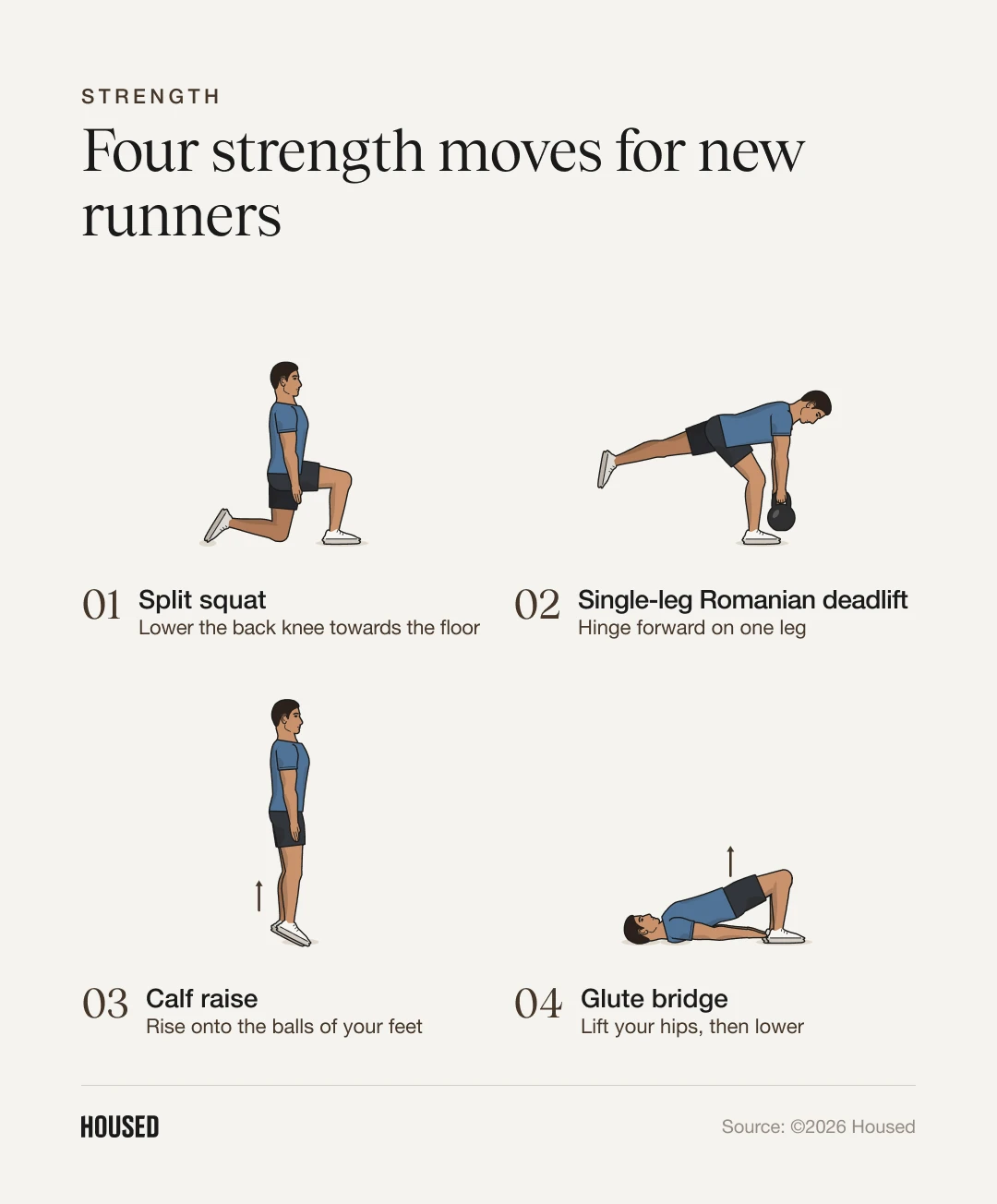
Start with four moves for the legs and hips, on two days a week: a split squat, a single-leg Romanian deadlift, a calf raise and a glute bridge.
- Split squat. Step one foot back, lower the back knee towards the floor, then stand.
- Single-leg Romanian deadlift. Hinge forward on one leg with a kettlebell, then stand tall.
- Calf raise. Rise onto the balls of your feet, then lower slowly.
- Glute bridge. Lie on your back, knees bent, lift your hips, then lower.
Start light, with a weight you could lift a few more times at the end of each set, and add load as each move gets easier.
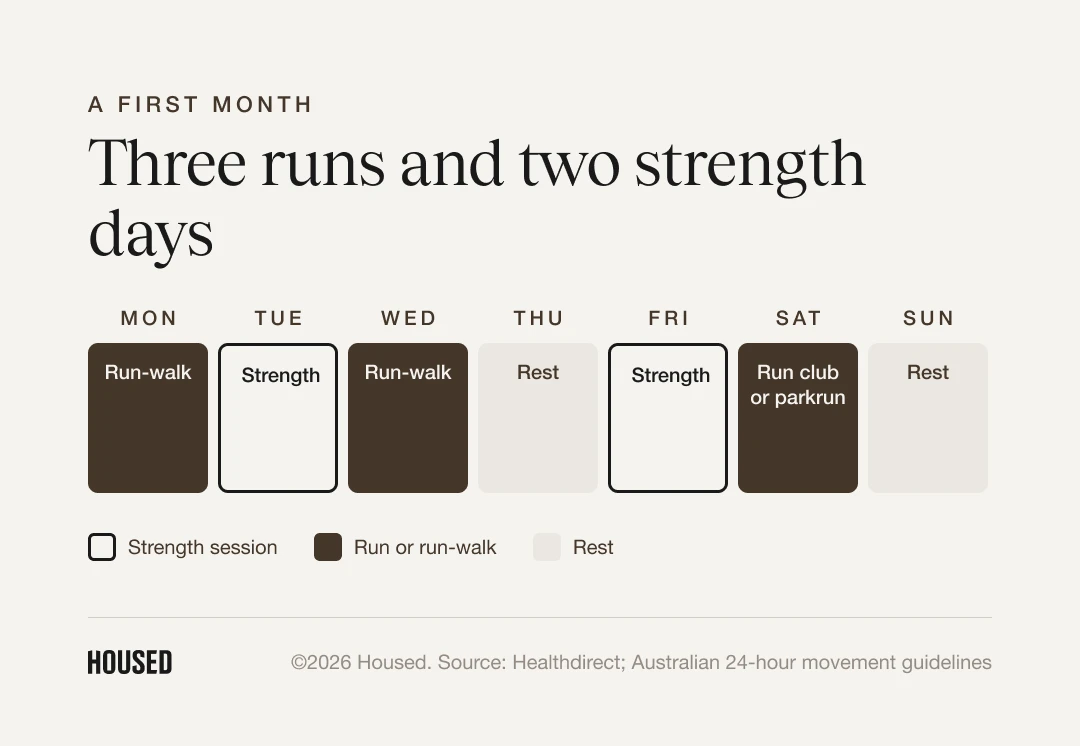
A week with three runs and two strength days meets Australia's movement guidelines and leaves a day without running between runs, in line with Healthdirect's advice. For example: run-walk on Monday and Wednesday, strength on Tuesday and Friday, a run club on Saturday, and rest on Thursday and Sunday.
What should you wear and bring to a run club?
Wear supportive running shoes and comfortable clothes you can move in. Bring water, sun protection for daytime runs, and a light or a bright top after dark.
Healthdirect's running tips recommend good, supportive running shoes and clothes that do not restrict how you move. They also suggest drinking extra water before and after a run, and wearing sunscreen and a hat.
You do not need special kit to start. A checklist for the first session:
- A pair of running shoes you have already worn on a few short runs, not a new pair on the day
- A water bottle, or a plan for water on longer routes
- A hat and sunscreen for morning and daytime runs
- A light or a bright top for early mornings and evenings
- Your phone, with the route and a contact number
Who should check with a GP before they start running?
Healthdirect suggests a check-up first if you are new to running and over 40, have a chronic condition, are pregnant, or are recovering from an injury or illness.
Healthdirect also advises seeing a doctor before you begin if you have an illness or injury. If you have a health condition where the impact on your bones may be a problem, see a doctor or physiotherapist first. If an injury is not improving after a few weeks, see your doctor or physio rather than running through it.
Summer adds a second risk. Sports Medicine Australia's hot weather fact sheet notes that the highest incidence of sports heat illness occurs in fun runs of 10 km and longer. Running close to exhaustion raises the risk. It recommends exercising at a moderate intensity in hot or humid weather, drinking water before and during exercise, and stopping if you feel unwell. Signs to stop include light-headedness, dizziness, nausea, unusual tiredness and losing coordination. On hot days, run early, choose shade, or move the session indoors to a treadmill.
How can a gym help you get ready for a run club?
A gym gives you a treadmill for run-walk intervals in any weather and the weights for your two strength days, so your first club run is not your first run.
A treadmill lets you set the speed and repeat the same session each week, which suits the early weeks of Couch to 5K. The free weights, kettlebells and machines on a gym floor cover the four strength moves above.
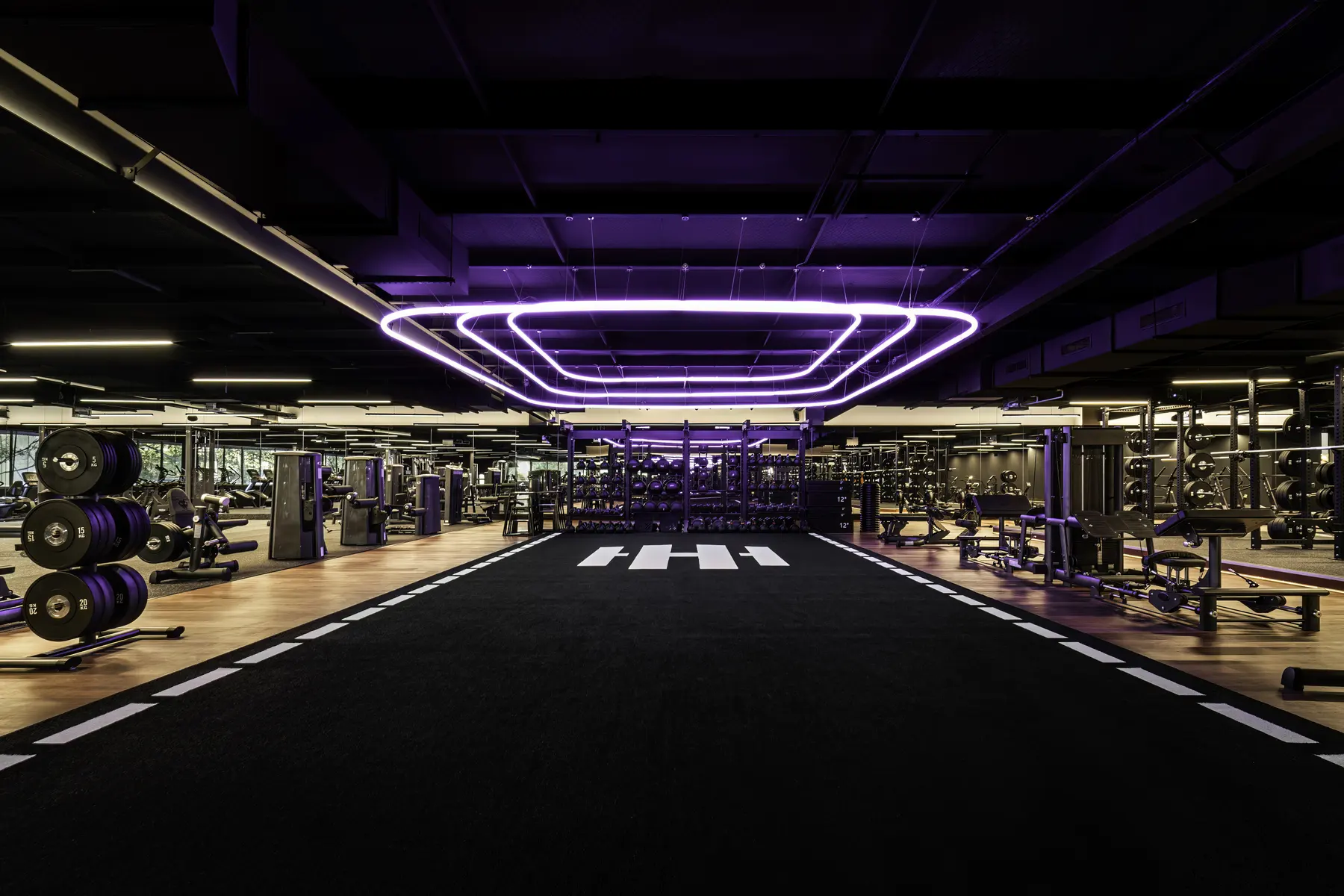
At Housed, the gym floor at our gym clubs has cardio machines, including treadmills, alongside free weights and strength machines. Group Training runs strength and cardio classes at Sydney CBD, Macquarie Park, Penrith and Gosford, including interval sessions on rowers, ski ergs and bikes. If you are new to classes, start with Team Hybrid. For a programme built around a race or a run club, a coach in personal training can set your strength sessions. Access all Housed locations with a Home or Full House Membership.
The first step is small. Pick one club or one parkrun this month, check its pace groups, and plan your two strength days around it. To try the gym side first, get a free pass.
Sources
- 01Strava. "Strava Releases Annual Year in Sport Trend Report, Revealing That Working Out Is No Longer About Burning Out." Press release, 4 December 2024. press.strava.com
- 02Dunne A, Quirk H, Bullas A, Haake S. "'My parkrun friends.' A qualitative study of social experiences of men at parkrun in Ireland." Health Promotion International 39(3), 2024. doi.org/10.1093/heapro/daae045
- 03parkrun Australia. "Parramatta parkrun." Event listing on KeepActive, accessed 17 November 2026. keepactive.com.au
- 04NHS. "Couch to 5K running plan." NHS Better Health, accessed 17 November 2026. nhs.uk
- 05TCS Sydney Marathon. "Athletic Hub: TCS Sydney Marathon Run Club." Accessed 17 November 2026. tcssydneymarathon.com
- 06Healthdirect Australia. "Running tips for beginners." March 2025. healthdirect.gov.au
- 07Healthdirect Australia. "Cardiovascular exercise." December 2025. healthdirect.gov.au
- 08Videbæk S, Bueno AM, Nielsen RO, Rasmussen S. "Incidence of running-related injuries per 1000 h of running in different types of runners: a systematic review and meta-analysis." Sports Medicine 45(7):1017-1026, 2015. doi.org/10.1007/s40279-015-0333-8
- 09Schuster Brandt Frandsen J, Hulme A, Parner ET, Møller M, Lindman I, Abrahamson J, et al. "How much running is too much? Identifying high-risk running sessions in a 5200-person cohort study." British Journal of Sports Medicine 59(17):1203-1210, 2025. doi.org/10.1136/bjsports-2024-109380
- 10Aarhus University. "Everything we thought about running injury development was wrong, study shows." News release, 7 July 2025. health.au.dk
- 11Australian Government Department of Health, Disability and Ageing. "Recommendations for adults (18 to 64 years)." Australian 24-hour movement guidelines, updated 3 June 2026. health.gov.au
- 12Lauersen JB, Bertelsen DM, Andersen LB. "The effectiveness of exercise interventions to prevent sports injuries: a systematic review and meta-analysis of randomised controlled trials." British Journal of Sports Medicine 48(11):871-877, 2014. doi.org/10.1136/bjsports-2013-092538
- 13Llanos-Lagos C, Ramirez-Campillo R, Moran J, Sáez de Villarreal E. "Effect of strength training programs in middle- and long-distance runners' economy at different running speeds: a systematic review with meta-analysis." Sports Medicine 54(4):895-932, 2024. doi.org/10.1007/s40279-023-01978-y
- 14KeepActive. "Running clubs, groups and coaches in New South Wales." Accessed 17 November 2026. keepactive.com.au
- 15Sports Medicine Australia. "Beat the heat: playing and exercising safely in hot weather." Fact sheet, 2011. sma.org.au