In this article
- What does a first HYROX race involve?
- What decides your HYROX finish time?
- How many weeks do you need to train for HYROX?
- How many days a week should you train for HYROX?
- How should you train your running for HYROX?
- How do you train for the HYROX stations?
- What is compromised running, and how do you train it?
- Should you do a race simulation before your first HYROX?
- How do you pace your first HYROX race?
- Should you race Open, Doubles or Relay for your first HYROX?
- What should the last two weeks before a HYROX race look like?
- Where can you train for HYROX at Housed?
The short answer: A first HYROX training plan builds three things: your running, your strength for the stations, and your ability to run on tired legs. Running makes up about half of race time, so it gets the most work. Train four or five days a week. Allow 8 to 16 weeks, depending on where you start.
You have booked a race. Or you are thinking about it. Now you need a plan.
Most people start with the stations. Sleds. Wall balls. Lunges. They look like the hard part. They matter. But the research points somewhere else first.
This training plan is built around what decides your finish time. It covers how many weeks you need, what a week looks like, how to train the run and the stations, and how to arrive at the start line ready to complete the race.
For the race format, the stations and race-day basics, start with our HYROX for Beginners guide. This page is about the plan.
What does a first HYROX race involve?
A HYROX race is eight 1 km runs. Each run is followed by one functional workout station. The format and the order are the same at all HYROX events, so you can train for exactly what you will face. HYROX describes itself as an indoor fitness race.
The stations, in order:
- 011,000 m SkiErg
- 0250 m sled push
- 0350 m sled pull
- 0480 m burpee broad jumps
- 051,000 m row
- 06200 m farmers carry
- 07100 m sandbag lunges
- 08100 wall balls
The weights depend on your division. These are HYROX's published weights, sled included:
| Division | Sled push | Sled pull | Farmers carry | Sandbag lunges | Wall ball |
|---|---|---|---|---|---|
| Women Open | 102 kg | 78 kg | 2 x 16 kg | 10 kg | 4 kg |
| Men Open | 152 kg | 103 kg | 2 x 24 kg | 20 kg | 6 kg |
| Women Pro | 152 kg | 103 kg | 2 x 24 kg | 20 kg | 6 kg |
| Men Pro | 202 kg | 153 kg | 2 x 32 kg | 30 kg | 9 kg |
Check the HYROX website before you train. Standards can change between seasons.
What decides your HYROX finish time?
Running decides the most. In research, running took about half of total race time, and faster runners finished higher. Strength stations matter too, especially for slower racers, who lose the most time there.
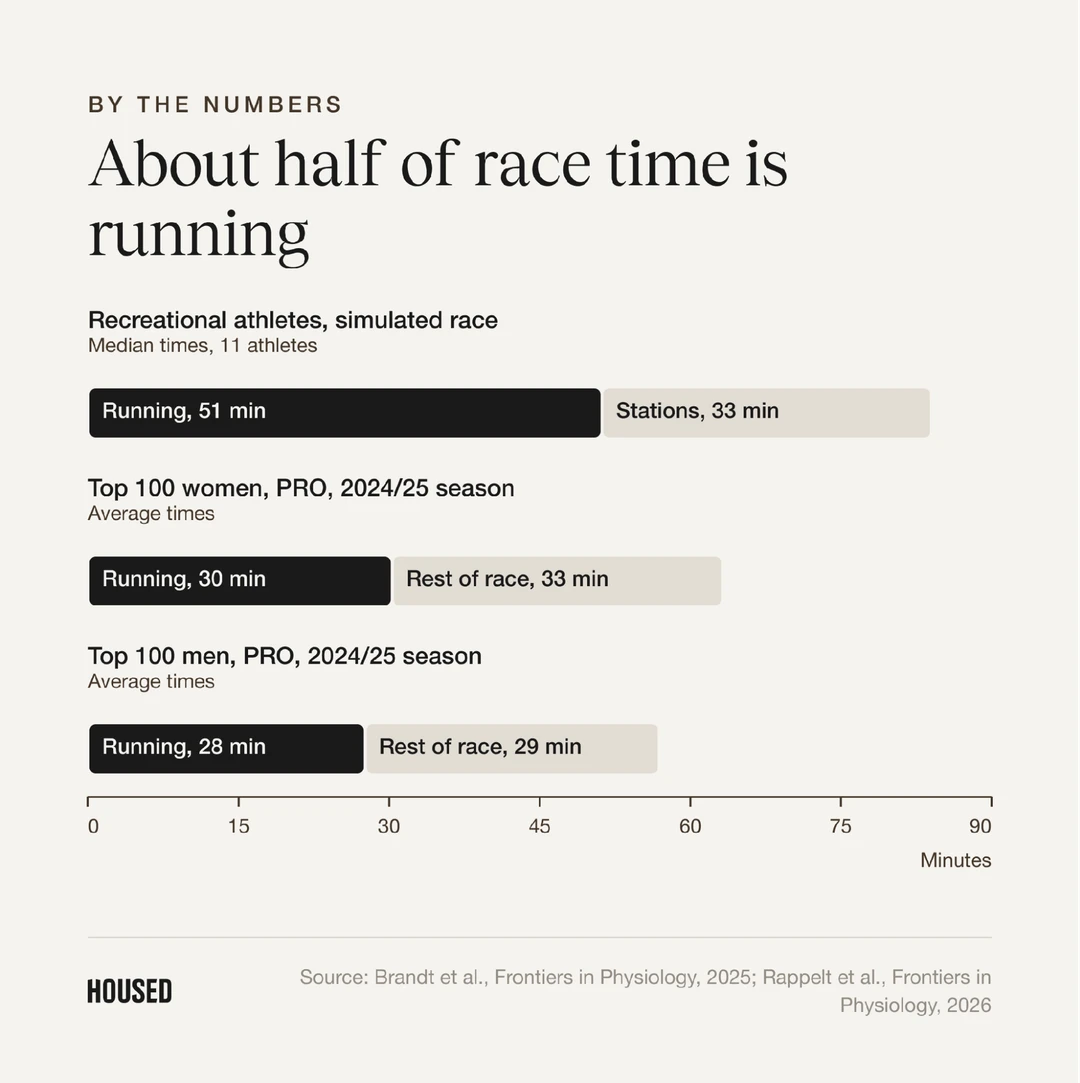
A 2025 study in Frontiers in Physiology put 11 recreational racers through a simulated race. Median finish time was 86.5 minutes. Running took 51.2 minutes. The stations took 32.8. The racers with a higher VO2 max, a measure of aerobic fitness, finished faster. So did those who did more endurance training each week. Grip strength and weekly strength training hours were not linked with finish time.
The authors summed up the race this way:
"Hyrox© is a HIFT modality with an emphasis on endurance capacity"
HIFT means high-intensity functional training.
A 2026 study in the same journal analysed 39,696 PRO and ELITE results over seven seasons. Running accounted for about 50% of total race time in every season. In the 2024/25 season, the top 100 women averaged 63 minutes 11 seconds, with 30 minutes 17 seconds of running. The top 100 men averaged 56 minutes 56 seconds, with 27 minutes 38 seconds of running. Faster running explained most of the improvement among elite athletes. But the strength stations shuffled the rankings more. Slower racers lost more time on them.
What that means for your plan:
- Running gets the most sessions.
- Strength gets two sessions a week, every week.
- You practise both together.
How many weeks do you need to train for HYROX?
Most people need 8 to 16 weeks for a first race. The right number depends on your starting point. Already running and lifting? Eight weeks can work. New to both? Give yourself 16 or more.
Find your starting point:
| Your starting point | Suggested lead-in | Focus first |
|---|---|---|
| Already run and lift regularly | 8 to 10 weeks | Running on tired legs, station practice |
| Runner, new to lifting | 12 weeks | Strength, sled and wall ball technique |
| Lifter, new to running | 12 weeks | Building weekly running slowly |
| New to both | 16 weeks or more | Consistency, easy running, basic lifts |
These are our coaching guidelines, not race rules. Your body sets the pace. If four weeks in your legs feel heavy every day, you added too much, too soon. Pull back for a week.
New to both? Do not start with race-specific sessions. Start by training four days a week for a month. Then build.
How many days a week should you train for HYROX?
Four or five days a week works for most first-timers. Two runs, two strength sessions and one session that mixes running with stations. Keep at least one full rest day.
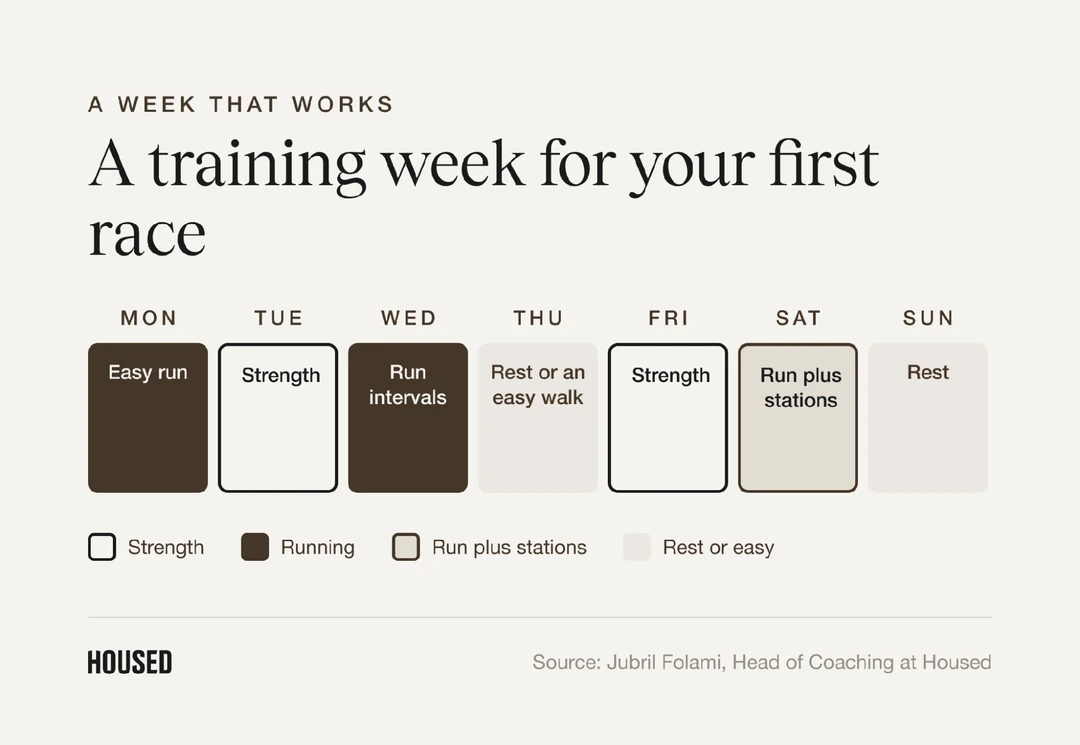
A sample week:
- Monday: easy run, 30 to 40 minutes at a pace where you can talk
- Tuesday: strength, lower body focus
- Wednesday: run intervals, such as 6 x 400 m with walking rest
- Thursday: rest, or an easy walk
- Friday: strength, upper body and carries
- Saturday: run plus stations
- Sunday: rest
Hard days. Easy days. Rest days. Each one has a job.
If you only have four days, drop one strength session in the last month. Keep the run plus stations day.
How should you train your running for HYROX?
Most of your running should be easy. Add one harder session a week. Build your weekly distance slowly. You need to cover 8 km between stations without your pace falling apart.
The 2025 study's authors recommended prioritising endurance, with a mix of moderate aerobic work and high-intensity intervals. They also noted that a lot of running raises injury risk. Their suggestion was to replace some running with other race-specific endurance work, such as rowing or the SkiErg.
That is how we build it.
- Easy runs: at a pace where you can hold a conversation. These build your base.
- Intervals: 400 m to 1 km repeats at a pace a little faster than your goal race pace, with walking or jogging rest.
- Rowing and SkiErg: extra aerobic work, with less pounding on your legs.
Add distance a little at a time. If something starts to hurt, swap a run for the rower that week.
Run on a treadmill sometimes too. It helps you learn an even pace.
How do you train for the HYROX stations?
Train strength twice a week, every week. Then practise each station's technique with light weights before you add speed. Strength stations such as the sleds, lunges and wall balls are where slower racers lose the most time.
Your strength sessions cover the patterns the stations use:
- Legs: squats and lunges, for the wall balls and sandbag lunges
- Hips and back: deadlifts or Romanian deadlifts, for the sled pull and carries
- Pushing: sled pushes, push-ups and presses, for the sled push and burpees
- Pulling: rows, for the sled pull, the rower and the SkiErg
- Grip and trunk: farmers carries with heavy dumbbells

Then add station practice. Once a week, pick two stations. Do three rounds of each at race weight, with full rest. Focus on clean movement. Speed comes later.
The 2026 study found the strength stations reshuffled rankings more than running did. For a first race, that is good news. Better technique on the sled can save more time than a faster kilometre.
What is compromised running, and how do you train it?
Compromised running is running straight after a station, on tired legs. Every kilometre after the first is run this way in a race. It feels different from fresh running, so it needs its own practice.
The 2025 study's authors recommended practising running combined with the other race movements. The aim is to run well when you are already tired.
This is the Saturday session in the sample week. A simple version:
- 01Run 1 km at a steady pace.
- 02Go straight into a station, such as 20 wall balls or 50 m of lunges.
- 03Rest two minutes.
- 04Repeat three or four times.
Start with lighter stations and shorter runs if you need to. Build to race distances over the weeks.
Notice your first 200 m after each station. Your legs will feel heavy. Your pace will feel slow. That is normal. Learn to settle into a steady rhythm quickly.
That is the skill. Not speed. Control.
Should you do a race simulation before your first HYROX?
Yes, one is enough. Do a half or full simulation about three to four weeks out. Treat it as practice for pacing and transitions, not as a test of your best time.
A simulation answers questions training sessions cannot:
- How fast can you run the first kilometre and still hold that pace for the seventh?
- Which station slows you down the most?
- How long do your transitions take?
- What do you need to eat and drink beforehand?
Run it at a steady, controlled effort. Note your time for every run and every station. Then adjust the next three weeks around what you learned.
Do not do a full simulation in the last two weeks. You want to arrive fresh, not proving something.
How do you pace your first HYROX race?
Start slower than you want to. Run your first kilometre at a pace you could hold all day. Aim for even run times. Most first-timers go out too fast and pay for it in the second half.
The race is hard enough without a fast start. In the 2025 study, racers spent 79.5% of total race time at "very hard" intensities, judged by heart rate.
A simple pacing plan:
- Runs 1 and 2: controlled. You should feel like you are holding back.
- Runs 3 to 6: steady. Settle in.
- Runs 7 and 8: whatever you have left.
Move straight into each station. Break hard stations into sets before you need to. Ten wall balls, a short breath, ten more.
Should you race Open, Doubles or Relay for your first HYROX?
Doubles is a good first race for many people. You run every kilometre together and split the station work. Open suits you if you want the full race alone. Relay suits a team of four friends or colleagues.
HYROX describes each division:
- Open: the standard race, alone.
- Pro: heavier weights, for experienced racers.
- Doubles: a pair runs together and splits each station as they choose.
- Relay: a team of four splits the race between them.
Doubles halves the station load. That suits someone whose running is ahead of their strength. Open asks you to carry every station alone, so make sure your strength sessions have been consistent.
Leave Pro for a later race.
What should the last two weeks before a HYROX race look like?
Cut your training volume. Keep a little intensity. Rest more. You will not gain fitness in the last two weeks. You can still lose freshness.
A simple taper:
- Two weeks out: cut total running and strength by about a third. Keep one short interval session.
- The final week: two or three short, easy sessions. A few race-pace efforts to stay sharp.
- Two days out: rest, or an easy 20-minute walk or jog.
Sleep well. Eat as you normally do. Do not try new shoes, new food or new gear on race day.
Pack the night before. Check your start time and your division weights.
Where can you train for HYROX at Housed?
Housed is a HYROX Training Club. Group Training at Housed Macquarie Park and Penrith includes classes that suit race prep, and our coaches can build a plan with you in personal training.
- Group Training: classes such as Team Hybrid, partner rounds that mix loaded movements with conditioning, and Athletic Conditioning, intervals on rowers, ski ergs and assault bikes. Both run at Macquarie Park and Penrith. Group Training also runs at Sydney CBD and Gosford. Check the timetable for your club.
- Personal training: a coach builds the plan around your starting point and race date, then adjusts it as you go.
- The gym floor: treadmills, rowers and strength equipment for the sessions in this plan.
New to Housed? Try the gym floor and a class first: get a free pass.
This plan is hard work. That is the point. Before you start, check with your GP if you have a heart condition, high blood pressure or another health condition, or if you are pregnant. High-intensity training is not the place to find out.
Pick your race. Count back the weeks. Book your first easy run this week.
Then show up for the next one.
Sources
- 01HYROX World. "The Fitness Race." hyrox.com
- 02Brandt T, Ebel C, Lebahn C, Schmidt A. "Acute Physiological Responses and Performance Determinants in Hyrox: A New Running-Focused High Intensity Functional Fitness Trend." Frontiers in Physiology 16:1519240, 2025. doi.org/10.3389/fphys.2025.1519240
- 03Rappelt L, Wiedenmann T, Held S, et al. "Longitudinal Performance Development in PRO and ELITE HYROX Competitions Across the First Seven Competitive Seasons." Frontiers in Physiology 17:1847569, 2026. doi.org/10.3389/fphys.2026.1847569