In this article
- What is the difference between reformer Pilates and mat Pilates?
- Is reformer or mat Pilates easier for beginners?
- Which builds more strength for beginners: reformer or mat Pilates?
- What does the research say about reformer vs. mat Pilates?
- Is mat Pilates harder than reformer Pilates?
- Do you need to learn mat Pilates before trying the reformer?
- How often should a beginner do reformer or mat Pilates?
- Is wall Pilates a good way to start Pilates at home?
- How do you choose between reformer and mat Pilates as a beginner?
- Where can you do reformer and mat Pilates at Housed?
The short answer: For most beginners, reformer Pilates is the easier place to start. The springs can support you while you learn, the footbar and straps show you where to move, and an instructor helps set the load. Mat Pilates builds the same control with just your body weight, so it often feels harder at first. Both build core strength.
Reformer Pilates vs. mat Pilates is one of the first questions new members ask. You've decided to try Pilates, then you open a timetable and find two kinds of class: one on a machine with springs and straps, and one on a mat on the floor. It isn't obvious which one a beginner should book.
Here's how the two compare, which one tends to suit beginners, what the research can and can't tell you, and how to start.
What is the difference between reformer Pilates and mat Pilates?
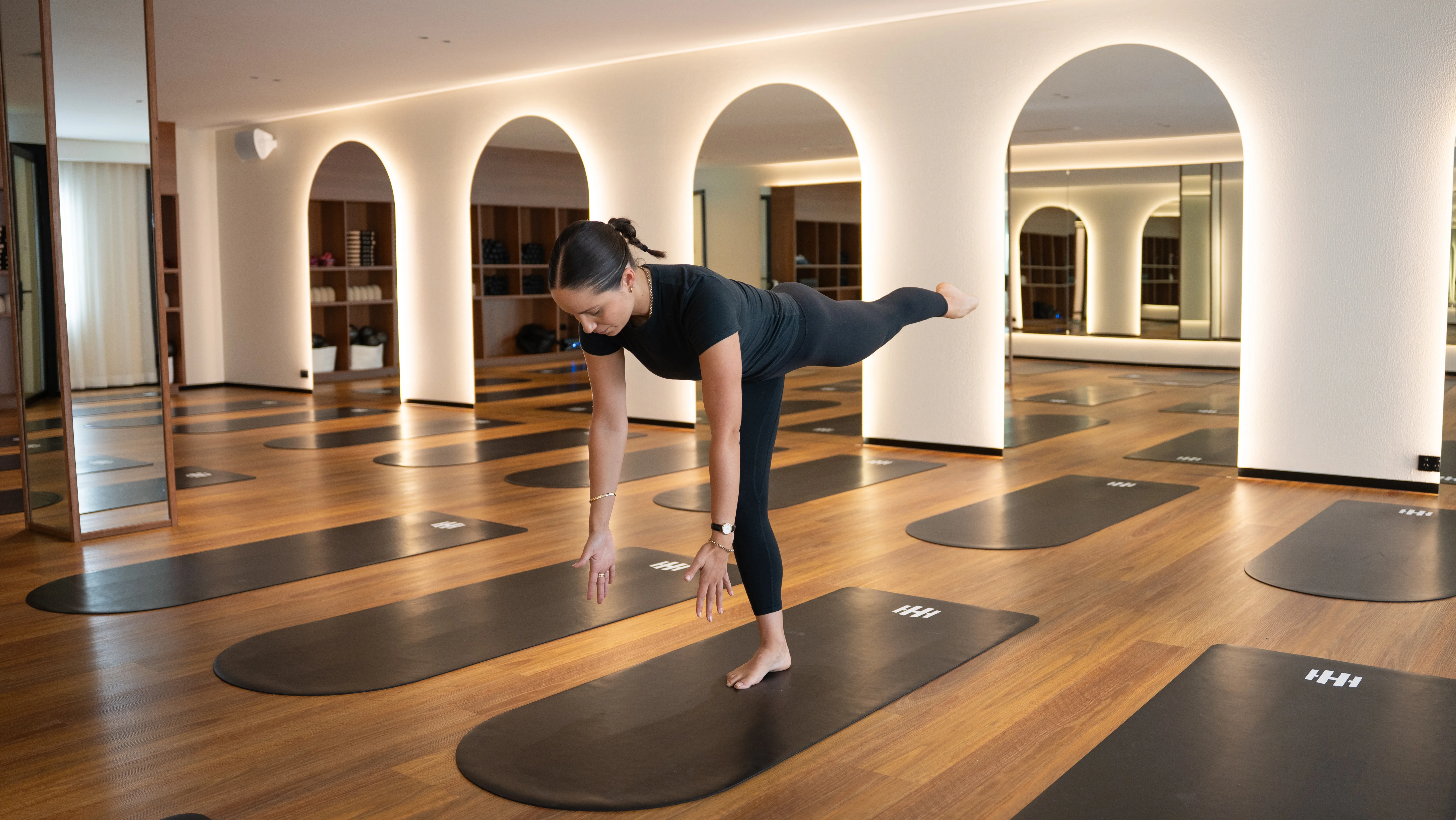
Reformer Pilates is done on a spring-loaded machine called a reformer, and mat Pilates is done on the floor with your own body weight. Both follow the same principles: breath, control, a steady trunk and precise movement.
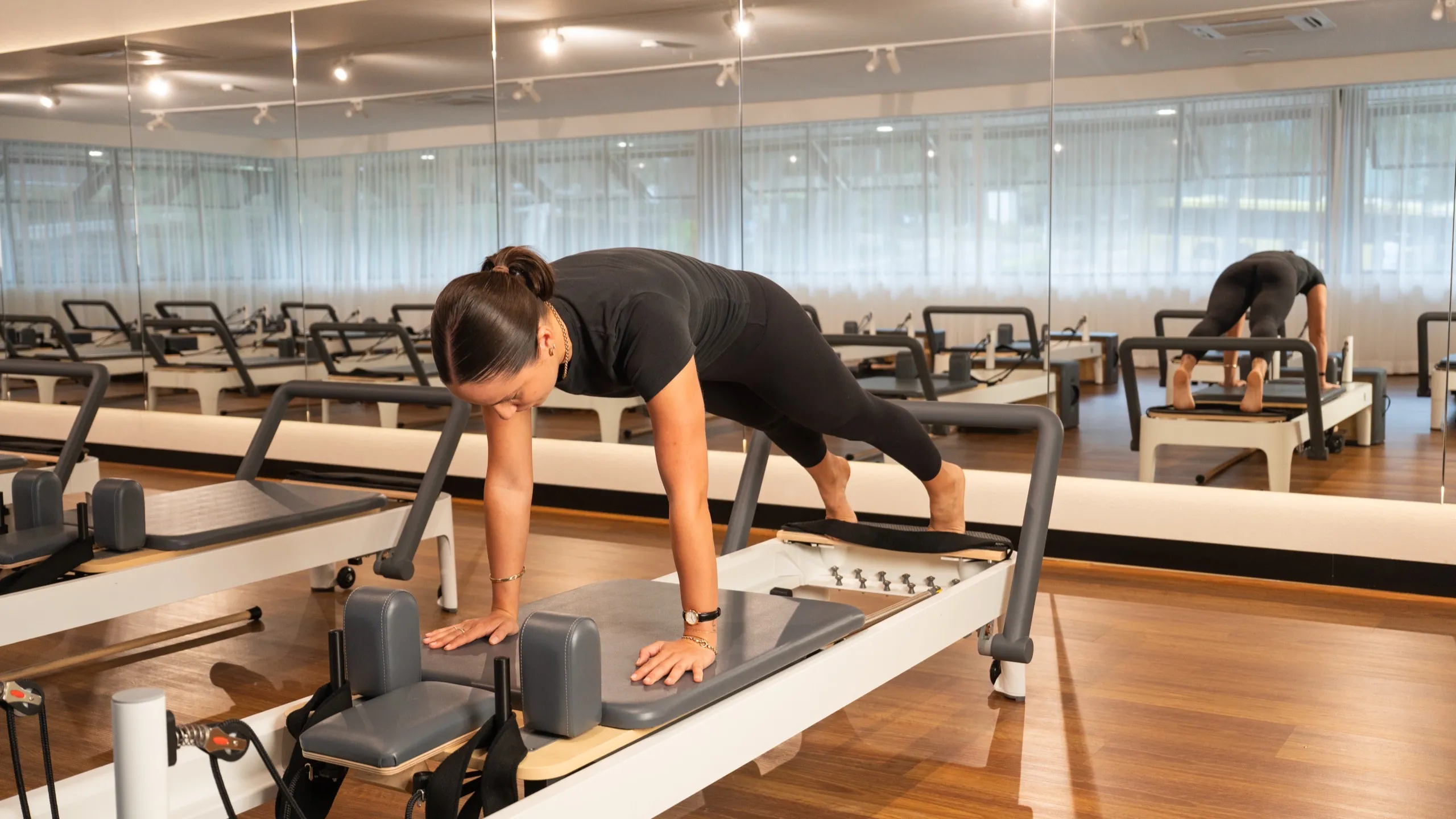
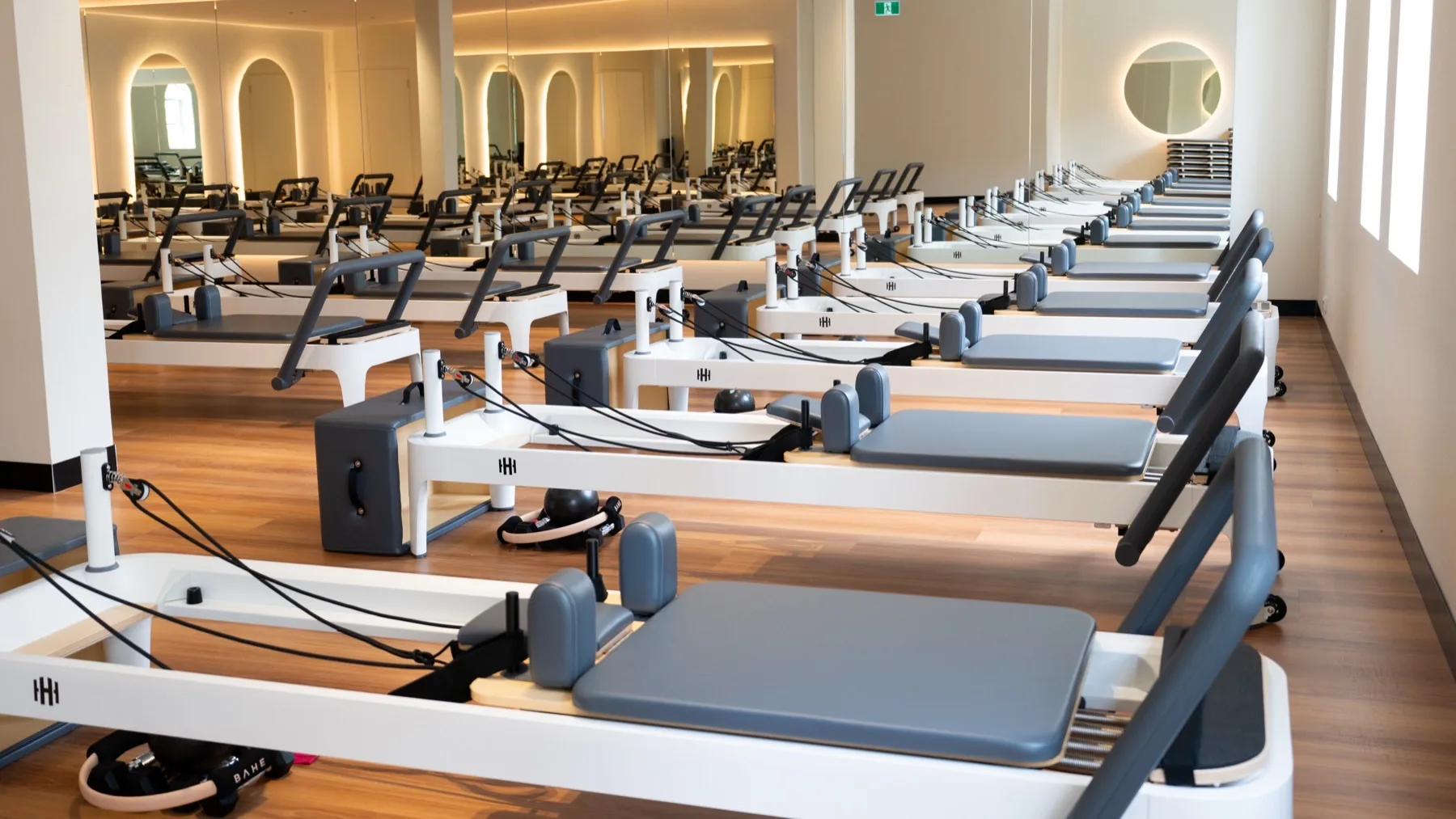
The difference is where the resistance and the support come from. Healthdirect describes a reformer as looking "like a bed frame with a moving platform, springs and an adjustable foot bar". You lie, kneel, sit or stand on the carriage, which slides along the frame and has shoulder rests to brace against when you lie down. You push or pull against the springs with your feet on the footbar or your hands and feet in straps, and changing the springs changes how hard each exercise feels. In mat Pilates, your body weight and gravity do that job, sometimes with a Pilates ring, a band or a small ball.
| Reformer Pilates | Mat Pilates | |
|---|---|---|
| Where you work | On a sliding carriage: lying, kneeling, sitting or standing | On a mat on the floor |
| Resistance | Springs, made lighter or heavier for each exercise | Your body weight, plus small equipment in some classes |
| Support | Springs, footbar and straps can guide and assist you | Nothing to lean on, so your muscles hold every position |
| How it gets harder | Spring changes, harder positions, slower tempo, one side at a time | Harder positions, longer holds, more reps, small equipment |
| What you need | A studio or club with reformers | A mat and some floor space |
| Where you can do it | In a class at a club or studio | At a club, at home or almost anywhere |
Is reformer or mat Pilates easier for beginners?
For most beginners, reformer Pilates is the easier place to start. The springs can make an exercise lighter while you learn it, and the footbar, straps and carriage show you where you're meant to be.
Mat Pilates looks simpler, but many people find it harder at first. With nothing to push against and nothing holding you, your own muscles have to support every position. A roll-up on the mat asks your abdominals to lift your whole upper body with no help. On a reformer, a spring or strap can share some of that load until you're strong enough to take more of it yourself.
That doesn't make mat Pilates the wrong choice for a beginner. It just means a beginner mat class may feel more demanding than you'd expect from something that looks so calm.
Try this: in your first Pilates class, whichever kind you book, ask the instructor which exercise they'd make simpler for you. It's a good habit from day one.
Which builds more strength for beginners: reformer or mat Pilates?
Both build strength, but reformer Pilates gives beginners more room to progress, because the springs change the load. Mat Pilates relies on body weight, so you progress by changing position, adding reps, holding longer or adding small equipment.
Your muscles get stronger when the work asks a little more of them over time. On the reformer, asking a little more can be as simple as a heavier spring for footwork. For some exercises a lighter spring is actually harder, because the spring was helping you. That two-way setting lets an instructor match each movement to you.
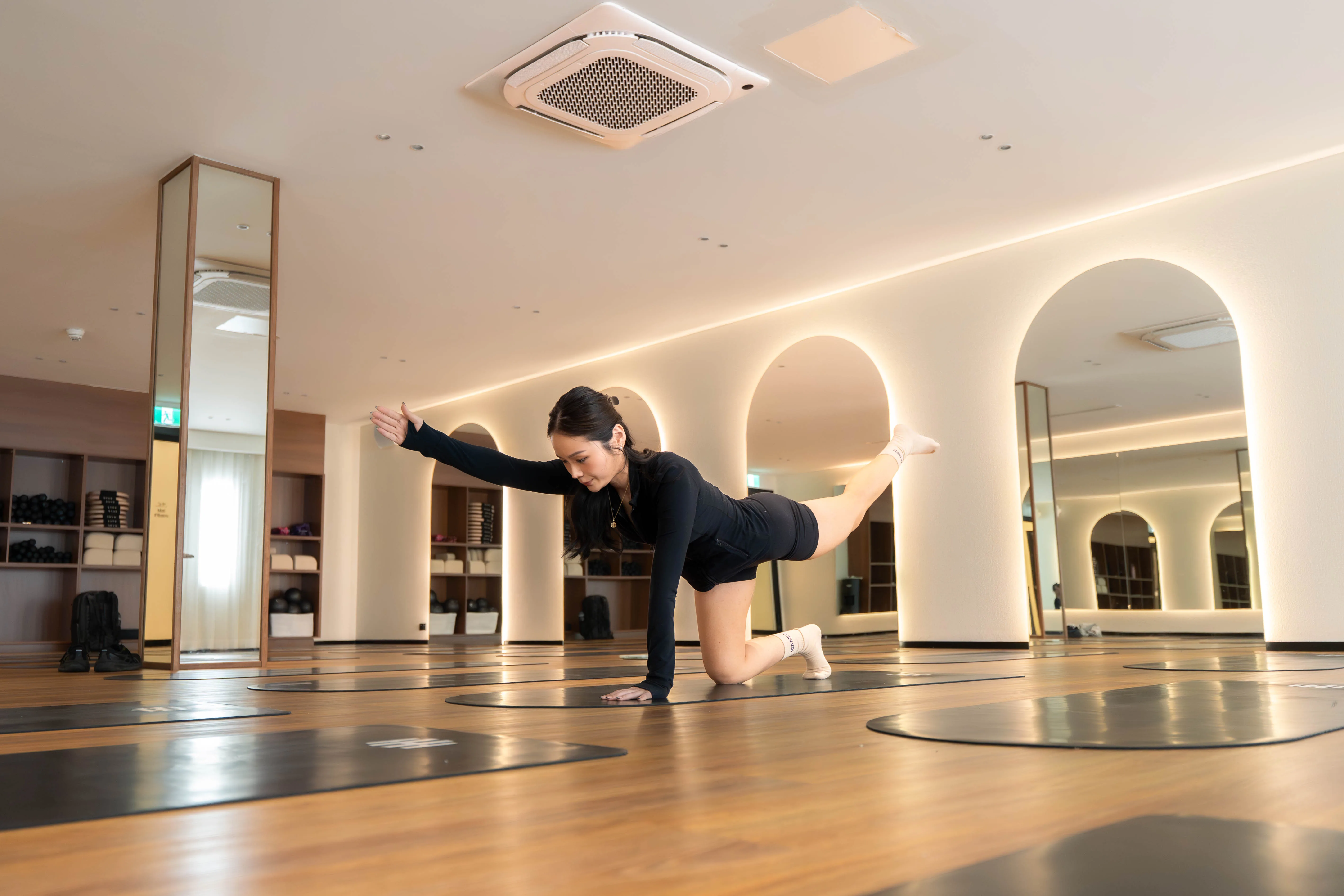
Mat Pilates still builds real strength and control, especially through your trunk, hips and shoulders. Holding your own body weight in a plank or a side-lying series is hard work, and there's enough variety in mat work to keep progressing for years.
Try this: on the reformer, pick one exercise and note the spring setting you use. In a month, check whether you've moved on from it.
What does the research say about reformer vs. mat Pilates?
There isn't much research comparing reformer Pilates and mat Pilates head to head, and what exists is small. Most Pilates studies don't separate the two at all, so the research doesn't name a winner.
What there is:
- Strength in general. A 2022 systematic review in Heliyon included 16 trials with 689 participants in total and pooled 11 of them in a meta-analysis. It found very low to low certainty evidence of no difference between Pilates and other exercise for strength, balance and flexibility. Its question was Pilates against other exercise, not mat against reformer.
- One exercise, two settings. A 2008 ultrasound study measured 26 experienced practitioners. The deepest abdominal muscle, the transversus abdominis, worked harder in one version of the Hundred on the reformer than on the mat.
- One head-to-head trial. A 2025 trial in PLOS One split 30 amateur male soccer players into reformer, mat and control groups for eight weeks. Both Pilates groups improved on several tests. The reformer group improved more than the mat group on agility, a passing test and a single-leg triple hop.
Ten young soccer players per group can't tell you much about a beginner starting Pilates. That leaves the question most beginners should be asking: which one will you keep doing?
Is mat Pilates harder than reformer Pilates?
Often, yes, at least at first. Mat Pilates gives you no springs or straps to lean on, so your own muscles have to create and control every movement, even in a beginner class.
The good news is that almost every mat exercise can be scaled. Here's what tends to make a mat exercise feel hard, and how to make it manageable:
- Long levers. Straight legs and arms put more load on your trunk. Bend your knees to shorten the lever.
- Lifting your own body weight. In a roll-up, your abdominals lift your whole upper body. Hold the backs of your thighs to help yourself up.
- Holding a position. Planks and side planks ask a lot of your shoulders. Lower to your knees and keep the same line through your body.
- Range. You don't need to go as far as the person next to you. A smaller range, done with control, still counts.
Do you need to learn mat Pilates before trying the reformer?
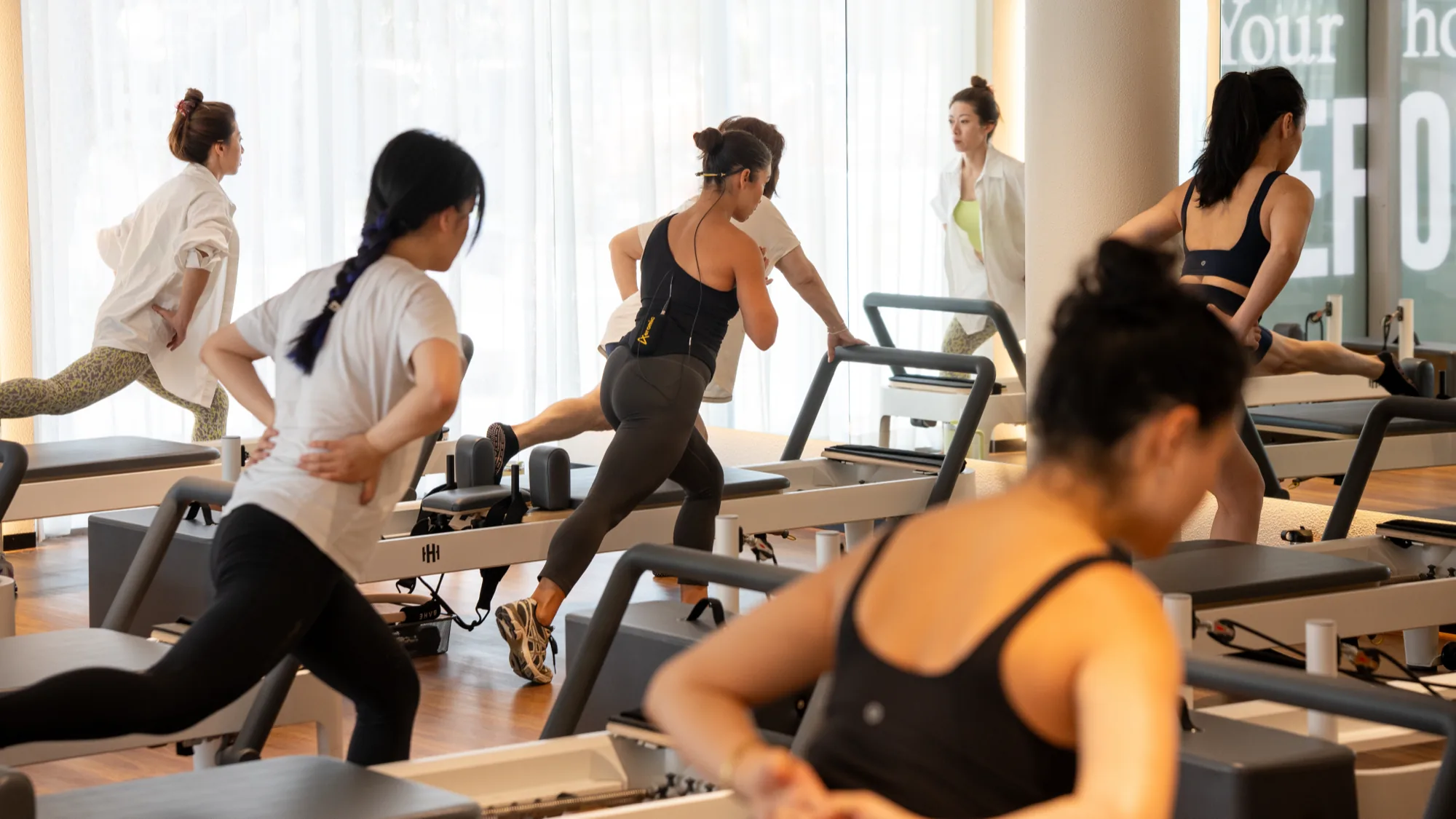
No. You can start on the reformer as a complete beginner, as long as you start in a beginner class. Housed reformer classes run at Beginner, Intermediate and Advanced levels, and at least 10 beginner classes are recommended before Intermediate.
Some instructors like beginners to learn the basics on the mat first. There's sense in that. Breathing, finding a neutral spine and keeping your trunk steady are the same on both. But a good beginner reformer class teaches those same basics, with the springs helping you feel them.
It's not just about which piece of equipment you learn on first, but about learning the basics properly. Get those right and they carry into every class you take, on the mat or the reformer.
Healthdirect's advice for anyone new is simple:
“If you are a beginner, let your Pilates instructor know so they can give you extra support during the class.”
Tell the instructor about any injury or health condition too. They can change the springs, the position or the exercise for you.
How often should a beginner do reformer or mat Pilates?
Two or three Pilates classes a week is a good place for most beginners to start. That's enough to learn the movements and feel progress, with rest days in between for your body to adapt.
It fits Australia's 24-hour movement guidelines for adults, which recommend muscle-strengthening activities on two or more days a week. More classes isn't always better when you're new. Training breaks you down. Recovery builds you up.
A sample beginner week:
- Monday: beginner reformer class
- Tuesday: rest, or an easy walk
- Wednesday: beginner reformer or mat class
- Thursday: rest, or five to ten minutes of stretching at home
- Friday: beginner reformer class
- Saturday and Sunday: something active you enjoy, and a proper rest day
Everyone has different needs when it comes to recovery. If you're feeling run down, sore for days or dreading the next class, take an extra rest day or drop back to two classes that week.
Is wall Pilates a good way to start Pilates at home?
Wall Pilates can be a useful way to practise at home, but it's a form of mat Pilates, not a replacement for a coached class. The wall gives you something to brace against for balance or to push into.
What wall Pilates does well:
- it needs only a mat and a clear wall
- it fits into ten minutes and a small space
- the wall gives you feedback on where your body is
What it can't do:
- there are no springs, so adding resistance is harder
- there's no instructor checking your form
For a beginner, a short home routine works best alongside classes, not instead of them.
Three to try against a wall:
- 01Bridge with feet on the wall. Lie on your back, feet flat on the wall, and lift your hips one vertebra at a time.
- 02Roll-down with your back to the wall. Stand with your back against the wall and peel away from it slowly, then roll back up.
- 03Wall push-up. Hands on the wall at shoulder height, body in one line, and lower with control.
How do you choose between reformer and mat Pilates as a beginner?
Choose the one that fits your goals, your week and what you'll keep coming back to. Both teach the same principles, and many people who start with one end up doing both.
Reformer Pilates may suit you if:
- you'd like the springs to help while you learn
- you want an easy way to add resistance as you get stronger
- you like clear cues and something to push against
- you already train at a club or studio with reformers
Mat Pilates may suit you if:
- you want to practise at home or while you travel
- you want to build control using your own body weight
- you're happy for the first few classes to feel challenging
- your club runs mat classes (at Housed, that's Macquarie Park)
Instead of saying to yourself "I need to pick the right one before I start", try "I'll start with one. I'll add the other when I'm ready."
Where can you do reformer and mat Pilates at Housed?
You can do reformer Pilates at Housed gym clubs and at our dedicated Pilates studios, and mat Pilates at Housed Macquarie Park. At our gym clubs, a Home membership includes the gym floor and three reformer classes a week.
- Pilates studios (reformer only): Bondi Junction, Chatswood and Five Dock, with beginner to advanced classes.
- Gym clubs with reformer Pilates: Macquarie Park, which also runs mat Pilates, Penrith, Sydney CBD, Thornleigh, Caringbah, Hurstville and Gosford.
New to our Pilates studios? See the intro offer for Bondi Junction, Chatswood or Five Dock.
See how reformer classes work, find the club closest to home or work on our locations page, and check when beginner classes run on the timetable. If you're brand new to Pilates, our Pilates for beginners guide covers your first few weeks.
Before you book, ask yourself one thing: which class would you still turn up to on a busy Wednesday? Start there.
Sources
- 01Pinto JR, Santos CS, Souza Soares WJ, et al. "Is Pilates Better Than Other Exercises at Increasing Muscle Strength? A Systematic Review." Heliyon 8(11):e11564, 2022. doi.org/10.1016/j.heliyon.2022.e11564
- 02Endleman I, Critchley DJ. "Transversus Abdominis and Obliquus Internus Activity During Pilates Exercises: Measurement With Ultrasound Scanning." Archives of Physical Medicine and Rehabilitation 89(11):2205-2212, 2008. doi.org/10.1016/j.apmr.2008.04.025
- 03Yılmaz O, Kaplan T, Batalik L. "Randomised Controlled Study on the Effects of Pilates Exercises in Soccer: Comparing Mat and Reformer Methods on Physical and Technical Performance." PLOS One 20(5):e0324129, 2025. doi.org/10.1371/journal.pone.0324129
- 04Healthdirect Australia. "Health benefits of yoga and Pilates." Last reviewed April 2025. healthdirect.gov.au
- 05Australian Government Department of Health, Disability and Ageing. "Recommendations for adults (18 to 64 years)." Australian 24-Hour Movement Guidelines, last updated 3 June 2026. health.gov.au